

Shedding fats depends on making a caloric deficit, which implies nailing a minimum of one (and ideally each) of two situations: consuming fewer energy than wanted to keep your present weight and burning extra energy than you eat.
That final half may be difficult. Determining the variety of energy burned by way of train isn’t any small job, as there are lots of elements that impression that whole (e.g., weight, intercourse, age, genes, train depth). What’s extra, analysis suggests we might overestimate what number of energy we burn in a single exercise by as a lot as 4 occasions the precise quantity!
However relaxation assured, it may be accomplished. Right here, we assist minimize by way of the confusion. Take into account this your primer on energy burned throughout train.
2 Largest Components in Energy Burned: Length and Depth
On the subject of caloric burn from train, period and depth are the 2 key elements that decide your ultimate tally.
“Of the 2, depth is a very powerful, as a result of it influences how lengthy your metabolism stays elevated when you cease understanding,” says Trevor Thieme, C.S.C.S.
You may burn extra energy throughout an hour-long, steady-state cardio session than throughout a fast high-intensity interval coaching (HIIT) session. However that HIIT exercise will maintain your metabolism elevated lengthy after you’re accomplished exercising as your physique recovers.
This “afterburn” impact is named extra post-exercise oxygen consumption (EPOC). The longer and extra intense your exercise is, the longer and extra intense your restoration shall be — and the extra fats you’ll finally burn. Why? As a result of fats is what your physique makes use of to gasoline your restoration.
Calculating the precise variety of energy burned by way of EPOC may be troublesome, however based on a examine printed within the Worldwide Journal of Sport Diet and Train Metabolism, individuals who spent simply two minutes sprint-cycling burned sufficient energy within the 24 hours afterward to equal half an hour of steady-state biking.
Does weight have an effect on what number of energy you burn?
As a basic rule, the extra you weigh, the extra energy you’ll burn throughout train — or some other time. “That’s merely a operate of the power required to maneuver your physique,” says Thieme.
That stated, your muscle-to-fat ratio will even decide what number of energy you’ll burn each day: “A lean, muscular 180-pound man will burn extra energy than an chubby 180-pound man throughout the identical exercise just because the muscular man has extra ‘metabolically lively’ tissue,” Thieme says.
Does peak have an effect on what number of energy you burn?
Top can have an effect on the variety of energy burned by way of train, however solely as a result of peak influences weight.
“In the event you’re tall, you’re seemingly going to weigh extra [than someone who’s shorter],” says Tim Church, M.D., M.P.H., Ph.D., chief medical officer at Wondr Well being. Nevertheless, in the event you weigh lower than somebody who’s shorter than you, your caloric burn might find yourself being decrease.
How Do You Calculate Energy Burned?

To determine what number of energy you burn from train, look to a way generally utilized by train scientists to estimate power expenditure: metabolic equivalents.
What’s a metabolic equal (MET)?
A metabolic equal, or MET, is a measure of the quantity of oxygen you eat throughout bodily exercise, expressed in energy. METs are calculated by multiplying 3.5 milliliters of oxygen per kilogram of physique weight by the variety of minutes of exercise. To make use of a real-life instance, a 70-kg (154-lb.) individual will burn roughly 1.5 energy per minute whereas sitting in a chair.
What are energy?
We all know energy are central to weight misplaced and gained, however few of us can clarify what a calorie is.
A calorie — or Calorie, with a capital “C” — is known as a kilocalorie, which implies it’s composed of 1,000 energy. One Calorie can warmth 1 kilogram of water by 1 diploma Celsius.
Your physique makes use of the vitamins (e.g., macronutrients, micronutrients, and phytonutrients) within the Energy you eat to gasoline bodily exercise, digest meals, maintain your mind sharp, and way more.
The truth is, roughly 60 to 75 % of the energy you want per day get used as much as maintain your physique performing at relaxation. This is named your basal metabolic price (BMR), and it varies from one individual to a different. Key elements that decide BMR embody age, physique mass, intercourse, genetics, and organ weight. There are a number of on-line calculators that can provide you an estimated BMR.
Energy Burned Throughout Totally different Sorts of Train
Fortunately, you don’t must be a scientist or mathematician to determine the variety of energy burned throughout your exercise.
The Compendium of Bodily Actions supplies MET values for a variety of actions, whereas Cornell College presents an on-line calculator the place you may enter your weight, MET worth to your exercise (from the Compendium), and time to simply calculate the variety of energy you may anticipate to burn.
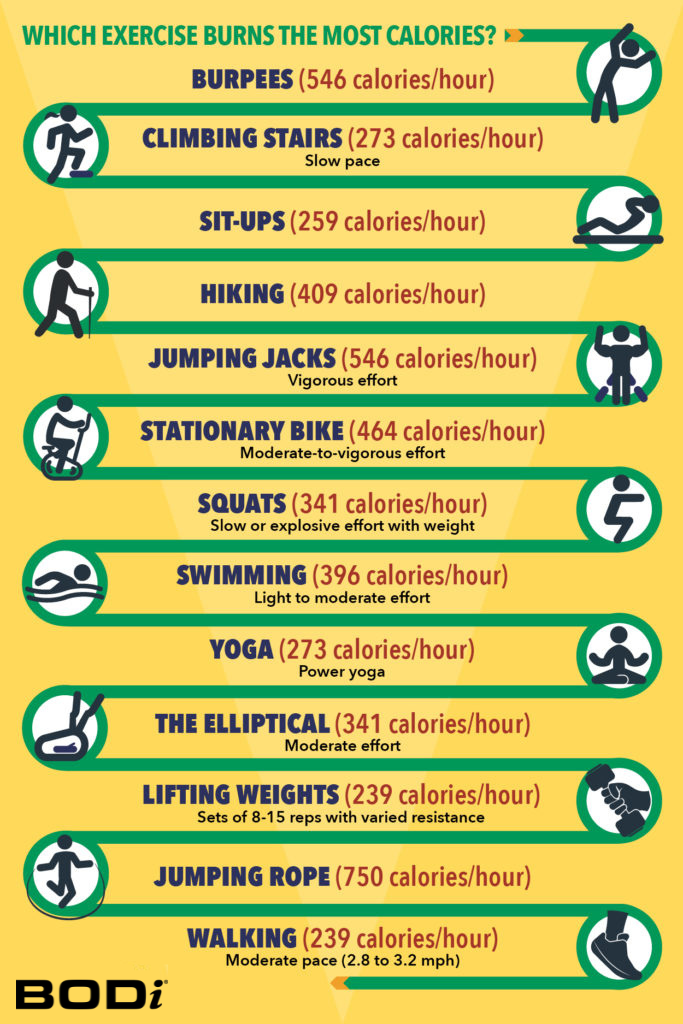
We’ve used each assets to offer you estimates for the variety of energy a 150-pound individual can burn performing quite a lot of bodily actions.
1. Strolling (239 energy/hour)

Stroll at a average tempo (2.8 to three.2 mph) on a stage floor and also you’ll rack up a minimum of 3.5 METs. Choose up the tempo to a brisk 3.5 mph, nevertheless, and also you’ll nab 4.3 METs, which works out to 293 energy/hour.
2. Leaping rope (750 energy/hour)

At 11.0 METs, leaping rope is akin to operating at a tempo of seven mph (that’s 8.5 minutes per mile). Plus, leaping actions have been proven to promote stronger bones.
3. Lifting weights (239 energy/hour)

Construct muscle mass and strengthen your bones with some good old style resistance coaching and also you’ll rack up 3.5 METs. And as you’ve already discovered, including muscle to your body means you’ll burn extra energy each day.
4. Elliptical (341 energy/hour)

Hop on the joint-friendly elliptical and pedal away at a average effort to get 5.0 METs.
5. Yoga (273 energy/hour)

There are a number of yoga types, and every presents its personal stage of depth. Energy yoga, one of many extra intense variations of this historic type of meditation, gives you 4.0 METs. Hatha yoga, which is usually slower and gentler, presents solely 2.5 METs (171 energy/hour).
6. Swimming (396 energy/hour)

Swimming laps at a lightweight or average effort gives you a low-impact exercise that gives 5.8 METs. Bump up the depth to a vigorous effort, nevertheless, and also you’ll get 9.8 METs (668 energy/hour).
7. Squats (341 energy/hour)

The squat is a multi-joint train that recruits a number of giant muscle teams, together with the glutes and quadriceps. Do them and also you’ll reap 5.0 METs.
8. Stationary bike (464 energy/hour)

Biking at moderate-to-vigorous effort will not be solely simpler in your joints than different types of cardio train (specifically, operating), nevertheless it’ll additionally internet you 6.8 METs.
9.Leaping jacks (546 energy/hour)

Leaping jacks are thought-about a vigorous type of calisthenics, which is a class of train that entails body weight actions. They’re additionally value 8.0 METs.
10. Mountain climbing (409 energy/hour)

Spending outing in nature will internet you roughly 6.0 METs, which is able to solely improve in the event you add weight (like a vest) or climb hilly terrain.
11. Sit-ups (259 energy/hour)

Reasonable-effort calisthenics like old-school sit-ups clock in at 3.8 METs.
12. Climbing stairs (273 energy/hour)

Whether or not you’re on a StairMaster or climbing the steps at work, you’ll rating 4.0 METs in the event you climb at a sluggish, straightforward tempo. However in the event you choose it as much as a quick tempo, you’ll get 8.8 METs (600 energy/hour).
13. Burpees (546 energy/hour)

At 8.0 METs, burpees are a full-body, high-intensity calisthenic train. The truth is, a 2014 examine discovered that performing burpees presents cardiovascular advantages much like doing dash intervals on a motorbike.